Update: 3rd day from kegging.
12FRM is very good. It's better than 12, a bit lighter, it doesn’t have so much of the earthy MO taste that took a few drinks to get used to with 12, smoother (my wife is helping me with this), she says it is "boozy, smooth, refreshing drink with body and she’s VERY happy".
Post #52 made 13 years ago
So the free range beer 12FRM is definitely even nicer than 12. All agree here. So I’m wrapping up with my sober conclusion, finished the tasting stage  (off to get my first one for the evening in a minute).
Conclusion: For my IPA as described: There is no need to insulate or re-heat the mash when it is done at room temperature, and the beer tastes better if you don't!
(This conclusion is from a single test batch that I am very happy with. Further study required)
Thanks everyone for your help!
(off to get my first one for the evening in a minute).Conclusion: For my IPA as described: There is no need to insulate or re-heat the mash when it is done at room temperature, and the beer tastes better if you don't!
(This conclusion is from a single test batch that I am very happy with. Further study required)
Thanks everyone for your help!
Guinges
Post #53 made 13 years ago
The 12FRM keg just “blew”. It was kegged just over two weeks ago. It was very sad at the end. I can’t say the taste improved at any stage. It was great with all its characters, all the way along, right from kegging after a 10 day ferment. It did become crystal clear at the end. I believe it is a crime to age American IPA’s any way. I took some pictures. Sorry about the poor quality. I had already drunk half of the glass and was in a hurry to drink the rest.
For the next FRM batch, I’m going to do a 12FRM but put the single large hop addition right in, just after the mash out and bag removal, and leave the hops in, without heating for 30 mins, before heating up for the boil, to try out this FWH thing http://brewery.org/library/1stwort.html Let me know if I have got the FWH thing wrong as the link doesn't say how to do it with BIAB. I know you aren't supposed to put all the hops into the FWH, but I'm going to try it and go from there.
For the next FRM batch, I’m going to do a 12FRM but put the single large hop addition right in, just after the mash out and bag removal, and leave the hops in, without heating for 30 mins, before heating up for the boil, to try out this FWH thing http://brewery.org/library/1stwort.html Let me know if I have got the FWH thing wrong as the link doesn't say how to do it with BIAB. I know you aren't supposed to put all the hops into the FWH, but I'm going to try it and go from there.
You do not have the required permissions to view the files attached to this post.
Guinges
Post #54 made 13 years ago
Guinges,
FWH Means you put the "Bittering" hops in just as you pull the bag! This lets the hops sit in the water as the temperature rises to the boil. This is the only hops you put in. The rest of the hops go in per the recipe. When you put the hops in as (First Wort Hopping) The magic (that no one yet fully understands) happens. I have done a lot of FWH and I have yet to see a big difference. However I usually forget to compare until I am almost done with the keg and (or) I am drunk and will (Do it when I am done drinking?) Yeah right!
FWH Means you put the "Bittering" hops in just as you pull the bag! This lets the hops sit in the water as the temperature rises to the boil. This is the only hops you put in. The rest of the hops go in per the recipe. When you put the hops in as (First Wort Hopping) The magic (that no one yet fully understands) happens. I have done a lot of FWH and I have yet to see a big difference. However I usually forget to compare until I am almost done with the keg and (or) I am drunk and will (Do it when I am done drinking?) Yeah right!
tap 1 Raspberry wine
tap 2 Bourbon Barrel Porter
tap 3 Czech Pilsner
tap 4 Triple IPA 11% ABV
Pipeline: Mulled Cider 10% ABV
http://cheesestradamus.com/ Brewers challenge!
tap 2 Bourbon Barrel Porter
tap 3 Czech Pilsner
tap 4 Triple IPA 11% ABV
Pipeline: Mulled Cider 10% ABV
http://cheesestradamus.com/ Brewers challenge!
-
- SVA Brewer With Over 100 Brews From United States of America
-
Free Range Mash Experiment
Post #55 made 13 years ago
Bob, there appears to be loads of different approaches to fwh but that's not how PP explained it to me and i think he got his info from PalmerBobBrews wrote:Guinges,
FWH Means you put the "Bittering" hops in just as you pull the bag! This lets the hops sit in the water as the temperature rises to the boil. This is the only hops you put in. The rest of the hops go in per the recipe. When you put the hops in as (First Wort Hopping) The magic (that no one yet fully understands) happens. I have done a lot of FWH and I have yet to see a big difference. However I usually forget to compare until I am almost done with the keg and (or) I am drunk and will (Do it when I am done drinking?) Yeah right!
See viewtopic.php?p=24809#p24809
Last edited by Lars on 02 Feb 2013, 04:46, edited 2 times in total.
Post #56 made 13 years ago
Thanks very much Lars! I read PP’s article. It was very interesting. He says that the principles of his article "come from an article that George Fix put out in 1995. You can change the rules as much as you like though”
I pasted Todds article (which followed pp’s) below. That’s all I needed Todd! to go ahead, be a bugger, and throw all of my hops into the FWH. I had a suspicion it would be good from my reading, and would be a sure way to test out the impact of FWH. Thanks!
I pasted Todds article (which followed pp’s) below. That’s all I needed Todd! to go ahead, be a bugger, and throw all of my hops into the FWH. I had a suspicion it would be good from my reading, and would be a sure way to test out the impact of FWH. Thanks!
thughes wrote:Lars,
I did an Amarillo/Citra pale ale this summer that was to die for. It was a basic pale ale grist (2 row 82.61%, munich 4.35%, vienna 4.35%, carapils 4.35%, and crystal-60 4.35%) with a FWH only, and then a dry hop. 1.057 OG, 5.25 gallons into fermenter, 6.25 gallons end of boil. (Is that enough to work with PP?)
The hopping schedule was FWH .5oz (14 grams) each of amarillo and citra pellet hops (10.1% aa and 13.9% aa respectively), 60 minute boil. This gave me @ 40 IBU's according to BeerSmith. Then after 2 weeks fermenting I added an ounce (28 grams) of each hop (pellets) for 7 day dryhop and then kegged. Yummmmm!!!!!!
You could probably substitute your cascades for the citra I used and be very happy with it!
---Todd
Last edited by GuingesRock on 02 Feb 2013, 06:50, edited 2 times in total.
Guinges
Post #57 made 13 years ago
Guinges,
What I wrote to you is correct. You have two different things going on. The hops that boil will only extract Alpha-acids (bittering) if boiled beyond 15 minutes (approx) and the aroma hops ( flavor oils ) are boiled away! So to use aroma hops in the beginning of the boil (for aroma) is pretty much of a waste because the aroma is gone! It will keep the Alpha-Acid oils to make a smoother tasting less harsh beer. Save the aroma hops for the late hopping or dry hopping.
John Palmer has revised many of the statements in the free book on the web. I guess he didn't want to change the statements on the web so you buy the current and revised book?
Here is more reading material.....
http://beersmith.com/blog/2008/03/17/th ... echniques/
http://brewery.org/library/1stwort.html
http://www.bacchus-barleycorn.com/catal ... cles_id=22
What I wrote to you is correct. You have two different things going on. The hops that boil will only extract Alpha-acids (bittering) if boiled beyond 15 minutes (approx) and the aroma hops ( flavor oils ) are boiled away! So to use aroma hops in the beginning of the boil (for aroma) is pretty much of a waste because the aroma is gone! It will keep the Alpha-Acid oils to make a smoother tasting less harsh beer. Save the aroma hops for the late hopping or dry hopping.
John Palmer has revised many of the statements in the free book on the web. I guess he didn't want to change the statements on the web so you buy the current and revised book?
Here is more reading material.....
http://beersmith.com/blog/2008/03/17/th ... echniques/
http://brewery.org/library/1stwort.html
http://www.bacchus-barleycorn.com/catal ... cles_id=22
Last edited by BobBrews on 02 Feb 2013, 22:21, edited 2 times in total.
tap 1 Raspberry wine
tap 2 Bourbon Barrel Porter
tap 3 Czech Pilsner
tap 4 Triple IPA 11% ABV
Pipeline: Mulled Cider 10% ABV
http://cheesestradamus.com/ Brewers challenge!
tap 2 Bourbon Barrel Porter
tap 3 Czech Pilsner
tap 4 Triple IPA 11% ABV
Pipeline: Mulled Cider 10% ABV
http://cheesestradamus.com/ Brewers challenge!
-
- SVA Brewer With Over 100 Brews From United States of America
-
Post #58 made 13 years ago
Bob, but there is a lot that I have read on FWH that it isn’t only about the bittering factor. I was just reading the section in Brad Smith’s book (same guy that wrote your first link) on FWH. I see that he also has had good success with putting all the hops into the FWH. He says “I have experimented with using FWH exclusively” and he says he had good results. He says “FWH will produce a more complex, blended hop flavor”.
Apparently, from other sources I read FWH, isn’t just about smoother bittering taste. There are new experiences in hop flavour to be had, and that’s what I’m after. Apparently those flavours are preserved during the boil, and it’s something to do with the lower ph that is effected by the FWH process.
The theory is faulty on this and full of supposition. I think that experience might be the key here. I’m going to try using cascade, and putting it all in the FWH. Just to see how it tastes and how it compares to my normal house beer.
At the end of your first (Brad Smith) link, he says: “Overall, I have been very pleased with the effect first wort hopping has had on my beers. I have taken to using it on a larger variety of beer styles recently with good results. FWH seems to produce a more complex, pleasing and harmonic hop flavor and aroma that beer drinkers find pleasing”
Those are three great links you provided. I had read them already with my maniacal googling, and I previously linked to your second choice in #53 above. I think you picked out the best three though!
ps. The first para. in your third link says: "First wort hopping is an old, yet recently rediscovered process consisting of adding a large portion of the finishing hops to the boil kettle as the wort is received from the lauter tun. As the boil kettle fills with wort, the hops steep in the hot wort releasing their volatile oils and resins. The aromatic oils are normally insoluble and tend to volatlize during the boil. By letting the hops steep in the wort prior to boiling, the oils have more time to oxidize to more soluble compounds and a greater percentage is retained during the boil".
Apparently, from other sources I read FWH, isn’t just about smoother bittering taste. There are new experiences in hop flavour to be had, and that’s what I’m after. Apparently those flavours are preserved during the boil, and it’s something to do with the lower ph that is effected by the FWH process.
The theory is faulty on this and full of supposition. I think that experience might be the key here. I’m going to try using cascade, and putting it all in the FWH. Just to see how it tastes and how it compares to my normal house beer.
At the end of your first (Brad Smith) link, he says: “Overall, I have been very pleased with the effect first wort hopping has had on my beers. I have taken to using it on a larger variety of beer styles recently with good results. FWH seems to produce a more complex, pleasing and harmonic hop flavor and aroma that beer drinkers find pleasing”
Those are three great links you provided. I had read them already with my maniacal googling, and I previously linked to your second choice in #53 above. I think you picked out the best three though!
ps. The first para. in your third link says: "First wort hopping is an old, yet recently rediscovered process consisting of adding a large portion of the finishing hops to the boil kettle as the wort is received from the lauter tun. As the boil kettle fills with wort, the hops steep in the hot wort releasing their volatile oils and resins. The aromatic oils are normally insoluble and tend to volatlize during the boil. By letting the hops steep in the wort prior to boiling, the oils have more time to oxidize to more soluble compounds and a greater percentage is retained during the boil".
Guinges
Post #59 made 13 years ago
Guinges,
FWH is indeed a "Magical Happening" Most everyone who is involved has given their 2 cents worth. At the end of every story about FWH they all seem to say "this is not understood but it seems to give great results" or something like that. The fact is nobody knows what is happening and everybody just loves the results. I really don't see much improvement doing a side by side but my results are not scientific. I may not be genetically sensitive to it or 5 ounces of dry hops may be concealing and covering up the improvement??
FWH is indeed a "Magical Happening" Most everyone who is involved has given their 2 cents worth. At the end of every story about FWH they all seem to say "this is not understood but it seems to give great results" or something like that. The fact is nobody knows what is happening and everybody just loves the results. I really don't see much improvement doing a side by side but my results are not scientific. I may not be genetically sensitive to it or 5 ounces of dry hops may be concealing and covering up the improvement??
tap 1 Raspberry wine
tap 2 Bourbon Barrel Porter
tap 3 Czech Pilsner
tap 4 Triple IPA 11% ABV
Pipeline: Mulled Cider 10% ABV
http://cheesestradamus.com/ Brewers challenge!
tap 2 Bourbon Barrel Porter
tap 3 Czech Pilsner
tap 4 Triple IPA 11% ABV
Pipeline: Mulled Cider 10% ABV
http://cheesestradamus.com/ Brewers challenge!
-
- SVA Brewer With Over 100 Brews From United States of America
-
Free Range Mash Experiment
Post #60 made 13 years ago
I wish I could brew more often! Then I wouldn't be so reluctant to muck around and experiment like this....
Post #61 made 13 years ago
Lars,
Your time will come. Keep soaking everything up and brew whenever you can! Keep everybody informed as to what your doing! Cheers!
Your time will come. Keep soaking everything up and brew whenever you can! Keep everybody informed as to what your doing! Cheers!
tap 1 Raspberry wine
tap 2 Bourbon Barrel Porter
tap 3 Czech Pilsner
tap 4 Triple IPA 11% ABV
Pipeline: Mulled Cider 10% ABV
http://cheesestradamus.com/ Brewers challenge!
tap 2 Bourbon Barrel Porter
tap 3 Czech Pilsner
tap 4 Triple IPA 11% ABV
Pipeline: Mulled Cider 10% ABV
http://cheesestradamus.com/ Brewers challenge!
-
- SVA Brewer With Over 100 Brews From United States of America
-
Post #62 made 13 years ago
Lars,
You seem to have fun trying different things with your brewing.
People say you can’t really spoil a brew unless you get an infection.
(...If you can’t be good, be careful! )
)
As Bob says… Please let us know what you are up to so we can join in. In my case, I would like to learn from your experiences.
You seem to have fun trying different things with your brewing.
People say you can’t really spoil a brew unless you get an infection.
(...If you can’t be good, be careful!
)As Bob says… Please let us know what you are up to so we can join in. In my case, I would like to learn from your experiences.
Guinges
Post #63 made 13 years ago
I know I have missed this thread at it's liveliest, but a few musings on brewing experiments. And a warning in advance, heretical statements coming!
I like the thought of well thought out experiments to find out what is happening with a system, and brewing is most definitely a system! The problem I have (heretical statement alert), is that BIAB is not really the method to use to determine the truth of otherwise of modifications to the brewing process. (Don't get me wrong, I love BIAB, it is a brilliant way to brew beer! ). But to get meaningful results requires consistency, PP and others highlight the fact that you cannot base any conclusions on a single brew. And the delightful thing with BIAB, is that you are not trying to control every variable to the smallest degree.
However, to determine what is important, the variables inherent in a system must be controlled. And the best guys to do this sort of experiment (heresy alert) are the 3V guys, I don't know if PP and crusty and the other ex 3V'ers still have their systems, or whether they would actually go back to those systems, but it is only with the likes of 3V HERMS or RIMS systems where there is some control of mash temperature, that you can actually start to investigate the effects of fixed or variable mash temperatures.
And water! A major variable. The only way to proceed is to start with RO water, equilibrate for atmospheric CO2, and adjust with a defined salt profile, then batch to batch some sort of consistency will start to show.
Given the delightful simplicity of BIAB though, I couldn't imagine anyone wanting to subject themselves to such a straightjacket! (Well, if I could afford the time and the money, I would fancy the challenge ).
).
However, if three or four Brewers could get together for brewday, using the same measuring equipment, and taking from a communal batch of water, some of the variability could be minimised.
I like the thought of well thought out experiments to find out what is happening with a system, and brewing is most definitely a system!
The problem I have (heretical statement alert), is that BIAB is not really the method to use to determine the truth of otherwise of modifications to the brewing process. (Don't get me wrong, I love BIAB, it is a brilliant way to brew beer! ). But to get meaningful results requires consistency, PP and others highlight the fact that you cannot base any conclusions on a single brew. And the delightful thing with BIAB, is that you are not trying to control every variable to the smallest degree. However, to determine what is important, the variables inherent in a system must be controlled. And the best guys to do this sort of experiment (heresy alert) are the 3V guys, I don't know if PP and crusty and the other ex 3V'ers still have their systems, or whether they would actually go back to those systems, but it is only with the likes of 3V HERMS or RIMS systems where there is some control of mash temperature, that you can actually start to investigate the effects of fixed or variable mash temperatures.
And water! A major variable. The only way to proceed is to start with RO water, equilibrate for atmospheric CO2, and adjust with a defined salt profile, then batch to batch some sort of consistency will start to show.
Given the delightful simplicity of BIAB though, I couldn't imagine anyone wanting to subject themselves to such a straightjacket! (Well, if I could afford the time and the money, I would fancy the challenge
).However, if three or four Brewers could get together for brewday, using the same measuring equipment, and taking from a communal batch of water, some of the variability could be minimised.
-
- SVA Brewer With Over 20 Brews From Great Britain
-
Post #64 made 13 years ago
Stevea, Thank you very much for taking an interest in this.
I notice you are from the town of the famous Cambridge University, and you have a scientific understanding.
I have a medical training, and thus have a goodish understanding of chemistry and biochemistry. An entire year of medical school was devoted to scientific research, and with evidence based medicine we are forever interpreting studies. But I have no idea where to go with this as I have very little (something like 18 batch) brewing experience, and my studies on brewing sadly leave me far behind some of the great masters who post on here, and who seem to know almost everything there is to know about brewing.
My objective was to find out if I needed to put a blanket on my BIAB pot. I also studied the biochemistry and I thought there might be advantages, in taste and efficiency, to letting the mash temperature ride down through a range.
I have satisfied myself that for my beer, there is no need to insulate, and it tastes better if I don’t. Others may find different results.
For me it was a BIAB study regarding whether the BIAB pot needs a blanket. But it may have implications for brewing in general. You may be right that 3V would be required to test this. I have no idea. It would certainly make a larger population of brewers available to test if testing were to be done. The people who do the real testing might be the commercial brewers, as they have the inclination, funding and the professionals to do controlled studies.
I’m happy with my little free range mashing thing. I don’t have the skills or the wherewithal to scientifically study this. PP is the kind of guy for studies, probably others on here, sounds like you are the kind of guy too.
Thanks
I notice you are from the town of the famous Cambridge University, and you have a scientific understanding.
I have a medical training, and thus have a goodish understanding of chemistry and biochemistry. An entire year of medical school was devoted to scientific research, and with evidence based medicine we are forever interpreting studies. But I have no idea where to go with this as I have very little (something like 18 batch) brewing experience, and my studies on brewing sadly leave me far behind some of the great masters who post on here, and who seem to know almost everything there is to know about brewing.
My objective was to find out if I needed to put a blanket on my BIAB pot. I also studied the biochemistry and I thought there might be advantages, in taste and efficiency, to letting the mash temperature ride down through a range.
I have satisfied myself that for my beer, there is no need to insulate, and it tastes better if I don’t. Others may find different results.
For me it was a BIAB study regarding whether the BIAB pot needs a blanket. But it may have implications for brewing in general. You may be right that 3V would be required to test this. I have no idea. It would certainly make a larger population of brewers available to test if testing were to be done. The people who do the real testing might be the commercial brewers, as they have the inclination, funding and the professionals to do controlled studies.
I’m happy with my little free range mashing thing. I don’t have the skills or the wherewithal to scientifically study this. PP is the kind of guy for studies, probably others on here, sounds like you are the kind of guy too.
Thanks
Guinges
Post #65 made 13 years ago
Stevea, an excellent musing and I think we would all agree about the water variable. Glad to see a dissenting opinion occasionally and also glad to hear you've given this crazy BIAB thing a chance. Also, you may want to consider that this particular thread documents one man's experience with not worrying about mash temps and the resulting quality of that beer. The "free range mash experiment" was just that, an experiment, and in no way should be taken as an inference as to how BIAB'ers regard the importance of such things.
That being said, I do take exception to your statement that "it is only with the likes of 3V HERMS or RIMS systems where there is some control of mash temperature, that you can actually start to investigate the effects of fixed or variable mash temperatures". I have an electric BIAB recirculating rig and can assure you that I can control the mash temp as accurately and precisely as any 3V HERMS or RIMS brewer and better than all the 3V insulated mash tun infusion brewers. I'm sure that other ex-3V brewers here will disagree about the lack of mash temp control too. Heck, all you need to do with BIAB is fire the burner for a minute or two thoughout the mash procedure to keep the temp consistent for the duration.
As to: "..the delightful thing with BIAB is that you are not trying to control every variable to the smallest degree." Have you seen the BIABacus? Just because one chooses to BIAB does not mean that one is not any less concerned with volumes, gravities, IBU's, weights, temperatures, time, etc, than one that uses other more traditional brew methods.
Just my opinion.......
---Todd
That being said, I do take exception to your statement that "it is only with the likes of 3V HERMS or RIMS systems where there is some control of mash temperature, that you can actually start to investigate the effects of fixed or variable mash temperatures". I have an electric BIAB recirculating rig and can assure you that I can control the mash temp as accurately and precisely as any 3V HERMS or RIMS brewer and better than all the 3V insulated mash tun infusion brewers. I'm sure that other ex-3V brewers here will disagree about the lack of mash temp control too. Heck, all you need to do with BIAB is fire the burner for a minute or two thoughout the mash procedure to keep the temp consistent for the duration.
As to: "..the delightful thing with BIAB is that you are not trying to control every variable to the smallest degree." Have you seen the BIABacus? Just because one chooses to BIAB does not mean that one is not any less concerned with volumes, gravities, IBU's, weights, temperatures, time, etc, than one that uses other more traditional brew methods.
Just my opinion.......
---Todd
Last edited by thughes on 04 Feb 2013, 07:00, edited 2 times in total.
WWBBD?
-
- SVA Brewer With Over 100 Brews From United States of America
-
Post #66 made 13 years ago
GR, I have to say I am really interested in the possibilities of varying the temperature during mashing. With the beta-Amylase nibbling off maltose from the end of straight chains (at the lower temperatures), and the alpha- chopping starches into smaller unfermentable chunks (at the higher end of the mashing temperature range).
Perhaps starting at a higher temperature for 20-30 minutes, and then actively cooling into the optimum temperature range for the beta, ie. produce a lot of smaller dextrins, and then chop them for high fermentability. Or conversely, mash at the lower temperature to produce a pool of fermentable sugar, then heat to the alpha optimum to chunk what is left, and see if it gives a good balance of maltose for fementation and more complex dextrins for body.
Or then perhaps I am just over thinking things!
Perhaps starting at a higher temperature for 20-30 minutes, and then actively cooling into the optimum temperature range for the beta, ie. produce a lot of smaller dextrins, and then chop them for high fermentability. Or conversely, mash at the lower temperature to produce a pool of fermentable sugar, then heat to the alpha optimum to chunk what is left, and see if it gives a good balance of maltose for fementation and more complex dextrins for body.
Or then perhaps I am just over thinking things!
-
- SVA Brewer With Over 20 Brews From Great Britain
-
Post #67 made 13 years ago
Hi Todd, yes I have seen the Biabacus and it does rather give the lie to my "not interested in the niggly details"!! 

And yep, never thought about the BIAB-recirc, that is going to give that temperature control you need lol!
lol!
As for my brewing experience, I used to do stovetop brewing back in the 70s, missed out a couple of decades, and started kits again a couple of years ago. I still fancied getting a bit more control of my brewing, and that is when I stumbled upon BIAB. And it was a revelation (as I couldn't really see having the room for a full brewing kit - as I thought I would need at the time!). So, a Burco boiler and some net curtain later! Like a pig in ... well, you know! I'm loving it
Steve
and it does rather give the lie to my "not interested in the niggly details"!! And yep, never thought about the BIAB-recirc, that is going to give that temperature control you need
lol!As for my brewing experience, I used to do stovetop brewing back in the 70s, missed out a couple of decades, and started kits again a couple of years ago. I still fancied getting a bit more control of my brewing, and that is when I stumbled upon BIAB. And it was a revelation (as I couldn't really see having the room for a full brewing kit - as I thought I would need at the time!). So, a Burco boiler and some net curtain later! Like a pig in ... well, you know! I'm loving it
Steve
-
- SVA Brewer With Over 20 Brews From Great Britain
-
Post #68 made 13 years ago
Thanks for the reply Steve, I was hoping I did not offend with my previous post. I have experimented a few times with step mashing (eg: 120 > 148 > 158 > mashout) and found no discernable benefit vs a single step mash (but my palate kind of sucks, your results may differ).
---Todd
---Todd
WWBBD?
-
- SVA Brewer With Over 100 Brews From United States of America
-
Post #69 made 13 years ago
Stevea,
Yes It’s interesting that the constant mash temperature idea is a compromise that doesn’t suit any of the enzymes (you mentioned strait jackets). The enzymes also work sequentially as you say. The alpha working breaking up starch at higher temperatures into non-fermentable dextrins provides more material for the beta, which works best at lower temperatures, to turn into fermentable sugars. So manipulating mash temperatures, should give the brewer more control over the final product, in terms of sugars available to the yeast to convert to alcohol, and residual dextrins to contribute to body.
Going from a lower temperature to a higher temperature during the mash doesn’t make any sense to me. It seems that that might work against both enzymes. Whereas, starting at a higher and more favourable temperature for alpha to break up as much of the starch as possible into dextrins, and then adjusting the degree of temperature range drop to control beta activity, would enable control of the dextrin/sugar ratio. Thus high temperature for maximum utilization of starch and then adjusting the lower end of the temperature range to adjust body and fermentable sugars.
Yes It’s interesting that the constant mash temperature idea is a compromise that doesn’t suit any of the enzymes (you mentioned strait jackets). The enzymes also work sequentially as you say. The alpha working breaking up starch at higher temperatures into non-fermentable dextrins provides more material for the beta, which works best at lower temperatures, to turn into fermentable sugars. So manipulating mash temperatures, should give the brewer more control over the final product, in terms of sugars available to the yeast to convert to alcohol, and residual dextrins to contribute to body.
Going from a lower temperature to a higher temperature during the mash doesn’t make any sense to me. It seems that that might work against both enzymes. Whereas, starting at a higher and more favourable temperature for alpha to break up as much of the starch as possible into dextrins, and then adjusting the degree of temperature range drop to control beta activity, would enable control of the dextrin/sugar ratio. Thus high temperature for maximum utilization of starch and then adjusting the lower end of the temperature range to adjust body and fermentable sugars.
Last edited by GuingesRock on 04 Feb 2013, 08:17, edited 2 times in total.
Guinges
Post #70 made 13 years ago
Todd, You only need a Step/Ramp mash if you don't "Cereal mash" the Oat/wheat/barley/rye un-malted grains.
The big brewers start a mash-in around 130F/55C, and ramp to "whatEVER" the recipe calls for.
The big brewers start a mash-in around 130F/55C, and ramp to "whatEVER" the recipe calls for.
Honest Officer, I swear to Drunk, I am Not God.
-
- SVA Brewer With Over 100 Brews From United States of America
-
Post #71 made 13 years ago
Only "gotcha" is that the beta enzymes are denatured (basically killed off) at temperatures that are optimal for the alpha activity. So by starting high you effectivly kill off the beta and therefore there will not be any beta enzyme activity when you "adjusting the degree of temperature range drop to control beta activity".GuingesRock wrote:Going from a lower temperature to a higher temperature during the mash doesn’t make any sense to me. It seems that that might work against both enzymes. Whereas, starting at a higher and more favourable temperature for alpha to break up as much of the starch as possible into dextrins, and then adjusting the degree of temperature range drop to control beta activity, would enable control of the dextrin/sugar ratio. Thus high temperature for maximum utilization of starch and then adjusting the lower end of the temperature range to adjust body and fermentable sugars.

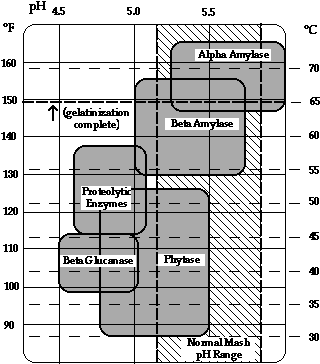
Phytase 86 - 126°F
Beta Glucanase 98 - 113°F
Peptidase 115 - 135°F
Protease 115 - 135°F
Beta Amylase 130 - 150°F
Alpha Amylase 155 - 167°F
Last edited by thughes on 04 Feb 2013, 09:37, edited 2 times in total.
WWBBD?
-
- SVA Brewer With Over 100 Brews From United States of America
-
Post #72 made 13 years ago
Hi Todd,
Thank you for your input and discussion.
I didn’t, and wasn’t suggesting that people should, start the mash at a temperature that would be high enough to denature the beta-amylase. I started mine at 156F and the temperature dropped to 146F over an 80 minute period with no insulation, at room temperature.
I think people get confused between the temperature range for optimal enzyme activity, and the temperature for denaturation. The two are different. There is a statement in John Palmers book that was quoted in #2 in this thread. I believe that statement is incorrect, and serves to add to the confusion.
Step/ramp mashing is increasing the temperature during the mash...the opposite of what I did.
Thanks
Thank you for your input and discussion.
I didn’t, and wasn’t suggesting that people should, start the mash at a temperature that would be high enough to denature the beta-amylase. I started mine at 156F and the temperature dropped to 146F over an 80 minute period with no insulation, at room temperature.
I think people get confused between the temperature range for optimal enzyme activity, and the temperature for denaturation. The two are different. There is a statement in John Palmers book that was quoted in #2 in this thread. I believe that statement is incorrect, and serves to add to the confusion.
Step/ramp mashing is increasing the temperature during the mash...the opposite of what I did.
Thanks
Guinges
Post #73 made 13 years ago
Because, during the free range mash, the temperature gradually drops: The bottom end of the range, and the time that the beta is held at around it's optimum temperature, could be adjusted by varying the mash time (not so free range). This could potentially be a method of controlling the beta-amylase activity and consequently the body and FG of the end product.
Because of the sequential enzyme deployment and the provision of near optimal temperatures for each enzyme during the temperature range of the mash. It may be possible, or even desirable, to reduce the overall mash time.
Reducing the mash time would reduce the range of the temperature drop. Mash times for full bodied beers could end up being less than normal, and potentially with greater efficiency of the mash.
Please note the frequent use of words like "may be", "could be", "possibly", "potentially" in the above.
Because of the sequential enzyme deployment and the provision of near optimal temperatures for each enzyme during the temperature range of the mash. It may be possible, or even desirable, to reduce the overall mash time.
Reducing the mash time would reduce the range of the temperature drop. Mash times for full bodied beers could end up being less than normal, and potentially with greater efficiency of the mash.
Please note the frequent use of words like "may be", "could be", "possibly", "potentially" in the above.
Guinges
Post #74 made 13 years ago
Good Day, a link about Mashing http://www.homebrewtalk.com/wiki/index. ... of_Mashing
Brings up the idea that "BETA" is active from 130F/54C up to 154F/68C and "ALPHA" is active from 140F/60C up to 165F/70C.
It is a good Idea to keep the mash above 140F/60C and below 154F/68C as long as you want, and that will keep BOTH enzymes working as long as they can. Of course there is only so much starch avaialble.
It appears there is No direction in this range of temperatures, so you can reheat and cool all you want!
Brings up the idea that "BETA" is active from 130F/54C up to 154F/68C and "ALPHA" is active from 140F/60C up to 165F/70C.
It is a good Idea to keep the mash above 140F/60C and below 154F/68C as long as you want, and that will keep BOTH enzymes working as long as they can. Of course there is only so much starch avaialble.
It appears there is No direction in this range of temperatures, so you can reheat and cool all you want!
Honest Officer, I swear to Drunk, I am Not God.
-
- SVA Brewer With Over 100 Brews From United States of America
-
Post #75 made 13 years ago
Nice link Joshua! Thanks
Do we really need to put a blanket on our BIAB pots?
My answer
Do we really need to put a blanket on our BIAB pots?
My answer
Last edited by GuingesRock on 05 Feb 2013, 05:22, edited 2 times in total.
Guinges
