I'm looking to brew my first big beer using BIAB in the next couple weeks. A 1.093 O.G. Scotch Ale. I've got two 7.5 gallon pots (about 28.3 L) but nothing large enough to do this all true BIAB style. I usually like to mash around 10 pounds (or about 4.5 kg) of grain with about 5 gallons (about 19 L) of water. This usually give me a couple inches of head space in the top of my pot to work with. My new recipe calls for about 15 pounds (about 6.8 kg) of grain and I'm thinking I won't be able to get my usual 5 gallons in there, and even if I do, I'm going to loose a a lot more to grain absorption. Normally I don't sparge, I just squeeze the bag and top off to my preboil volume with more water, but with this batch I'm thinking I'm going to have to do some sort of sparge. So here's what I'm thinking.
Fire up two 7.5 gallon turkey fryers with 4 gallons of water in each pot. Heat both pots of water to about 170ºF (about 76.5ºC). (Mash temp yet to be determined.) Line the first pot with a grain bag and add all of the grain to that first pot. Top off with water from the second pot if needed. (take careful notes as to how much extra water was added) Mash for 60 min. Pull grain bag and lightly squeeze. Place grain bag in colander over empty bucket. Measure water left in pot 1 then remove 2 gallons of wart from pot one to boil down for caramelization. Pour appropriate amount of hot water from pot two over grains and collect (second runnings) in bucket. Add second runnings to the first pot. Begin boil in first pot. If everything goes well, at this point I hope to have 5.5 gallons in my first pot. Plus the two gallons in the second pot. The two gallons will hopefully get boiled down to 1 gallon. I'm thinking with a 90 min. boil I will probably loose about a gallon to evaporation in the first pot, the same amount I hopefully now have in my second pot. So I'll add this to my first pot and be back up to 5.5 gallons. Now I will cool and pitch yeast as usual.
Anyone see any flaws in my thinking here. Anyone care to take a stab at helping me calculate grain absorption and evaporation and all that stuff so I know better what to expect? Or point me in the direction of where to find a calculator that can do this for me.
Post #2 made 14 years ago
Quick thought: Why not just figure calculations for a single vessel full volume BIAB and then split the grain and water equally between both pots, do 2 separate BIAB mashes, then combine the runnings into one pot for the boil?
WWBBD?
-
- SVA Brewer With Over 100 Brews From United States of America
-
Post #3 made 14 years ago
thughes wrote:Quick thought: Why not just figure calculations for a single vessel full volume BIAB and then split the grain and water equally between both pots, do 2 separate BIAB mashes, then combine the runnings into one pot for the boil?
That is a good point. I guess the only real reason, is that I don't have a second bag for the second pot. I suppose if this turns out to be to difficult, or unpredictable, I may have to get a second bag made up.
Last edited by de5m0mike on 29 Nov 2011, 04:33, edited 4 times in total.
Post #4 made 14 years ago
It's always a good idea to have a spare bag. You just never know when you are going to need it 
"It's beer Jim, but not as we know it."
Post #5 made 14 years ago
Good Day Guys, the 15 pounds of grain WILL take up about 4.75 gallon of space.....THughes is correct Split the recipe evenly into 2 batches for mashing, and, start the first batch boiling for 30 minutes, THEN add the 2nd batch for 60 minutes(hops,additions,Etc). This will get a 50% volume boil for 90 minutes for caramelization.
Honest Officer, I swear to Drunk, I am Not God.
-
- SVA Brewer With Over 100 Brews From United States of America
-
Post #6 made 14 years ago
Try using this calculator
http://www.biabrewer.info/viewtopic.php ... 269#p15251
I would do the mash in the first pot, and sparge in the second.
http://www.biabrewer.info/viewtopic.php ... 269#p15251
I would do the mash in the first pot, and sparge in the second.
Fermenting: -
Cubed: -
Stirplate: -
On Tap: NS Summer Ale III (WY1272), Landlord III (WY1469), Fighter's 70/- II (WY1272), Roast Porter (WY1028), Cider, Soda
Next: Munich Helles III
5/7/12
Cubed: -
Stirplate: -
On Tap: NS Summer Ale III (WY1272), Landlord III (WY1469), Fighter's 70/- II (WY1272), Roast Porter (WY1028), Cider, Soda
Next: Munich Helles III
5/7/12
Post #7 made 14 years ago
Stux, thanks for the link. I appreciate it and all the work you guys are doing on this stuff with the calculator and the BIABacus and all that, but as hard as I try, I just can't make sense out of a spread sheet.stux wrote:Try using this calculator
viewtopic.php?f=74&p=15269#p15251
I would do the mash in the first pot, and sparge in the second.
Any reason you would sparge in the second pot? When you say sparge are you talking about dunking the grains in a pot of water, or pouring the water over the grains like I suggested?
Last edited by de5m0mike on 29 Nov 2011, 07:10, edited 4 times in total.
Post #8 made 14 years ago
Dunking and swirling
The reason is because you're aiming for 1.093.
I'm on an iPhone right now so can't run the numbers, but basically the higher your preboil gravity, the more beneficial a sparge.
What is your hourly boiloff rate?
The reason is because you're aiming for 1.093.
I'm on an iPhone right now so can't run the numbers, but basically the higher your preboil gravity, the more beneficial a sparge.
What is your hourly boiloff rate?
Fermenting: -
Cubed: -
Stirplate: -
On Tap: NS Summer Ale III (WY1272), Landlord III (WY1469), Fighter's 70/- II (WY1272), Roast Porter (WY1028), Cider, Soda
Next: Munich Helles III
5/7/12
Cubed: -
Stirplate: -
On Tap: NS Summer Ale III (WY1272), Landlord III (WY1469), Fighter's 70/- II (WY1272), Roast Porter (WY1028), Cider, Soda
Next: Munich Helles III
5/7/12
Post #9 made 14 years ago
I don't have enough batches under my belt to know exactly what my hourly boil off rate is, but I usually loose close to 1 gallon per hour.
Post #10 made 14 years ago
Running some numbers...
21L in Fermenter with 1.093 with a 100% Golden Promise grain bill (scottish malt for a scottish beer )
)
Unrestricted, you have 45L of Mash volume, and you'll get 63.5% Into Boil Efficiency with 55-57% Into Fermenter efficiency.
That's a 11.45KG grain bill.
Now, lets do a half size batch...
11L into fermenter, 1L left behind, 5.625KG, 24.28 mash volume... that works...
67.5% Into Boil efficiency, 61% Into Fermenter...
Now lets try 1 Kettle for Mash and 1 for sparge, both are limited to 28L for "mash volume"
Impossible without a sparge
So, lets do a 13L sparge. That means we should have 27.8L of Dunk Sparge Volume and 28L of main mash volume
Dough-in 9.67KG of grain in 21.23L of water for 28L of mash. L:G = 2.2L quite thick
First run-off 'should' be 13.42L at 1.109 (wonder if that's reliable). That will leave about 50% of the sugars behind though.
Then dunk the bag into 13L in your other pot. That should dilute the remaining 50% of sugars by 50% and you should end up with 13L of 2nd runnings.
Add as much of your second runnings as you can to your boil pot, my estimate is 10.86L, and then you should have 25L of 1.084
Boil that down adding the remaining sparge as soon as you can, and then an additional 0.5L of topup
That *should* end up with 75% End of Boil Efficiency and 68.7% or so into fermenter efficiency.
...
I haven't factored in the second boil-down you want to do for caramelization... but the point really was to demonstrate the difference between splitting or sparging
which is basically an extra 1.5KG of grain.
Your choice
...
Attaching the calculator if you want to have a play with it
21L in Fermenter with 1.093 with a 100% Golden Promise grain bill (scottish malt for a scottish beer
)Unrestricted, you have 45L of Mash volume, and you'll get 63.5% Into Boil Efficiency with 55-57% Into Fermenter efficiency.
That's a 11.45KG grain bill.
Now, lets do a half size batch...
11L into fermenter, 1L left behind, 5.625KG, 24.28 mash volume... that works...
67.5% Into Boil efficiency, 61% Into Fermenter...
Now lets try 1 Kettle for Mash and 1 for sparge, both are limited to 28L for "mash volume"
Impossible without a sparge
So, lets do a 13L sparge. That means we should have 27.8L of Dunk Sparge Volume and 28L of main mash volume
Dough-in 9.67KG of grain in 21.23L of water for 28L of mash. L:G = 2.2L quite thick
First run-off 'should' be 13.42L at 1.109 (wonder if that's reliable). That will leave about 50% of the sugars behind though.
Then dunk the bag into 13L in your other pot. That should dilute the remaining 50% of sugars by 50% and you should end up with 13L of 2nd runnings.
Add as much of your second runnings as you can to your boil pot, my estimate is 10.86L, and then you should have 25L of 1.084
Boil that down adding the remaining sparge as soon as you can, and then an additional 0.5L of topup
That *should* end up with 75% End of Boil Efficiency and 68.7% or so into fermenter efficiency.
...
I haven't factored in the second boil-down you want to do for caramelization... but the point really was to demonstrate the difference between splitting or sparging
which is basically an extra 1.5KG of grain.
Your choice
...
Attaching the calculator if you want to have a play with it
You do not have the required permissions to view the files attached to this post.
Last edited by stux on 29 Nov 2011, 08:04, edited 4 times in total.
Fermenting: -
Cubed: -
Stirplate: -
On Tap: NS Summer Ale III (WY1272), Landlord III (WY1469), Fighter's 70/- II (WY1272), Roast Porter (WY1028), Cider, Soda
Next: Munich Helles III
5/7/12
Cubed: -
Stirplate: -
On Tap: NS Summer Ale III (WY1272), Landlord III (WY1469), Fighter's 70/- II (WY1272), Roast Porter (WY1028), Cider, Soda
Next: Munich Helles III
5/7/12
Post #11 made 14 years ago
Stux,
I'm going to have to read that more than a few times before it makes sense. The one thing I did get from it though is that I'm going to need to sparge.
The one thing I'm most confused by though is that you predict 75% end of boil efficiency. How did you come up with that number? Is that just an estimate? I usually get closer to 85%.
I'm going to have to read that more than a few times before it makes sense. The one thing I did get from it though is that I'm going to need to sparge.
The one thing I'm most confused by though is that you predict 75% end of boil efficiency. How did you come up with that number? Is that just an estimate? I usually get closer to 85%.
Post #12 made 14 years ago
I came up with it using my CE BIABcalc.
How that came up with it is a complicated question
For more info on the methodology used check this thread
http://www.biabrewer.info/viewtopic.php?f=74&t=1066
But essentially, the calculator simulates your brew to determine the numbers quite accurately. Because you are doing such a high gravity brew your efficiency is going to plummet, unless you sparge
How that came up with it is a complicated question
For more info on the methodology used check this thread
http://www.biabrewer.info/viewtopic.php?f=74&t=1066
But essentially, the calculator simulates your brew to determine the numbers quite accurately. Because you are doing such a high gravity brew your efficiency is going to plummet, unless you sparge
Fermenting: -
Cubed: -
Stirplate: -
On Tap: NS Summer Ale III (WY1272), Landlord III (WY1469), Fighter's 70/- II (WY1272), Roast Porter (WY1028), Cider, Soda
Next: Munich Helles III
5/7/12
Cubed: -
Stirplate: -
On Tap: NS Summer Ale III (WY1272), Landlord III (WY1469), Fighter's 70/- II (WY1272), Roast Porter (WY1028), Cider, Soda
Next: Munich Helles III
5/7/12
Post #13 made 14 years ago
Thanks again for you help on this Stux. Like I said before, I suck at understanding spread sheets but I'm giving it another try. I really want to figure this out. What exactly is Kettle Loss? Line 16. I usually pour the entire contents of my boil, trub and all, into the fermenter. Should I enter "0" or try to estimate what I would loose transferring from primary to secondary?
Post #14 made 14 years ago
Kettle Loss is how much you leave behind in the kettle. You should use 0 if you leave nothing
Fermenting: -
Cubed: -
Stirplate: -
On Tap: NS Summer Ale III (WY1272), Landlord III (WY1469), Fighter's 70/- II (WY1272), Roast Porter (WY1028), Cider, Soda
Next: Munich Helles III
5/7/12
Cubed: -
Stirplate: -
On Tap: NS Summer Ale III (WY1272), Landlord III (WY1469), Fighter's 70/- II (WY1272), Roast Porter (WY1028), Cider, Soda
Next: Munich Helles III
5/7/12
Post #15 made 14 years ago
Btw another approach for your wee heavy would be to produce less beer
Maybe 4 gallons?
Also try a longer boil. I use a 2 hr boil for my Scottish ales, gives a darker maltier colour. And would increase evaporation too
Maybe 4 gallons?
Also try a longer boil. I use a 2 hr boil for my Scottish ales, gives a darker maltier colour. And would increase evaporation too
Fermenting: -
Cubed: -
Stirplate: -
On Tap: NS Summer Ale III (WY1272), Landlord III (WY1469), Fighter's 70/- II (WY1272), Roast Porter (WY1028), Cider, Soda
Next: Munich Helles III
5/7/12
Cubed: -
Stirplate: -
On Tap: NS Summer Ale III (WY1272), Landlord III (WY1469), Fighter's 70/- II (WY1272), Roast Porter (WY1028), Cider, Soda
Next: Munich Helles III
5/7/12

Post #17 made 14 years ago
Somewhat off topic for this particular thread, but I briefly gave up BIAB for brewing in a "solid bag" consisting of a bucket with false bottom. I had some success but the extra hassling around persuaded me to go back to BIAB. In the meantime I'd sold my bags - they all went to good homes so good brewing Karma prevailshashie wrote:It's always a good idea to have a spare bag. You just never know when you are going to need it

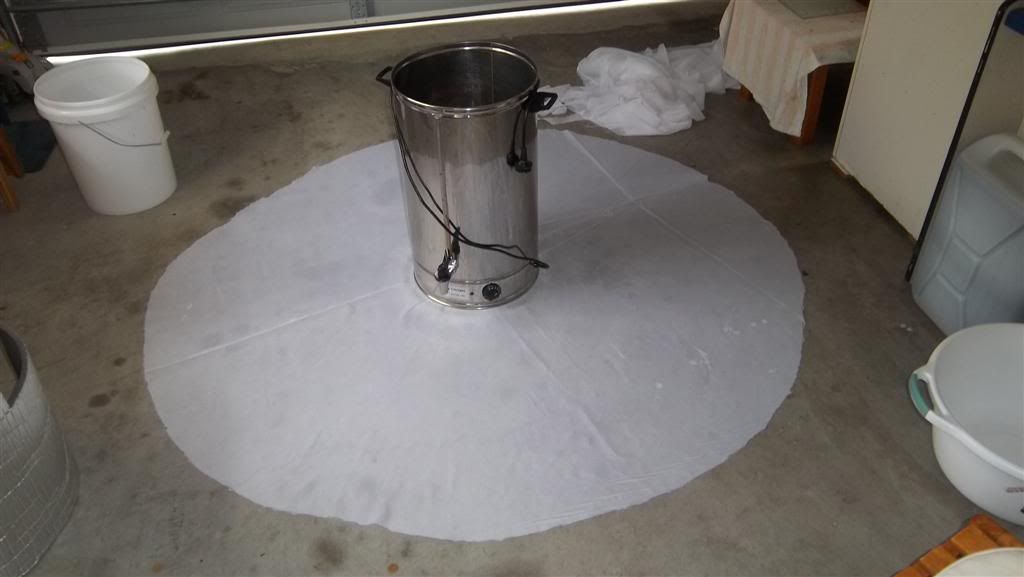
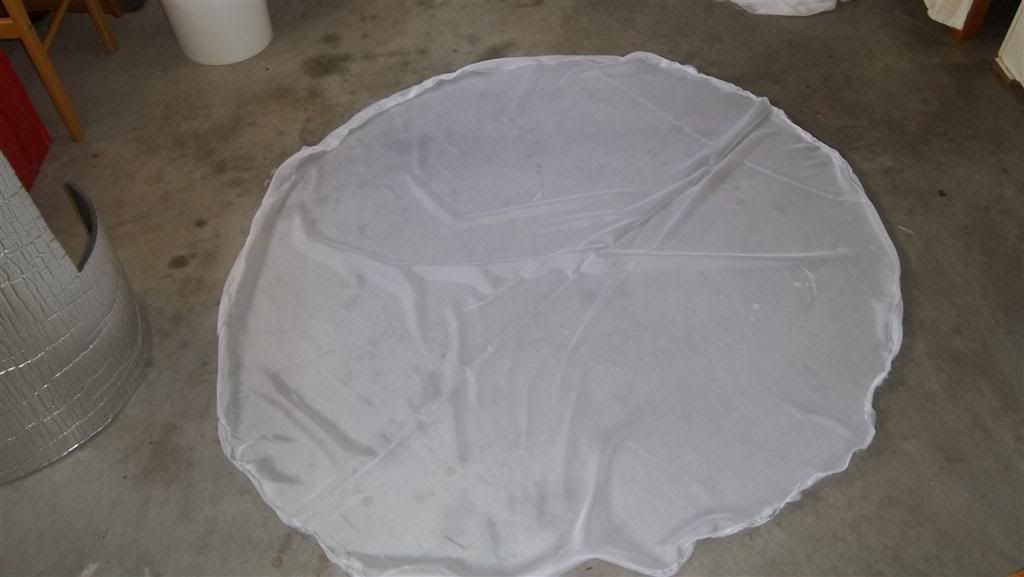
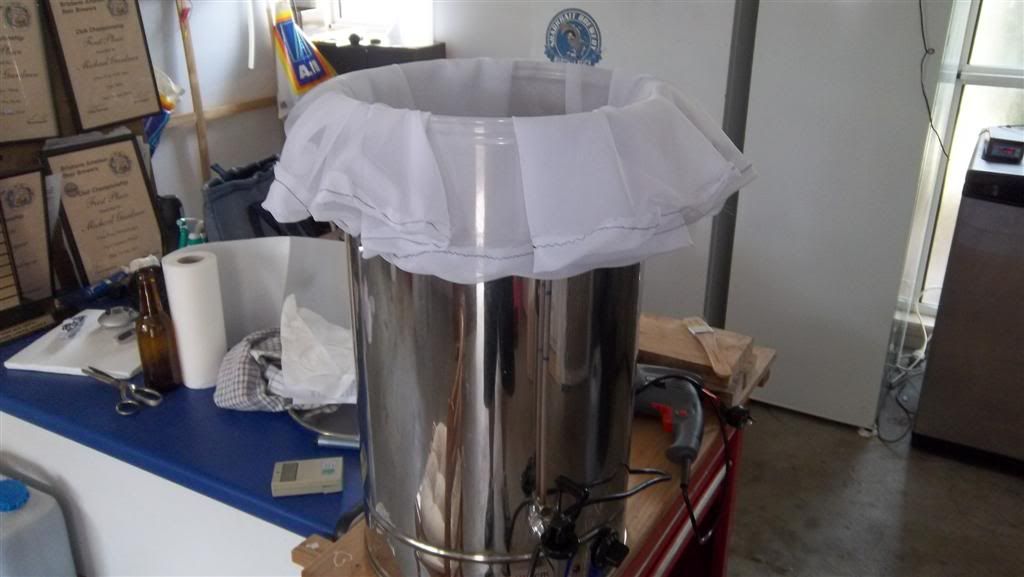
I just went to a fabric superstore and got a big sheet of voile, spread it on the garage floor, drew out and cut a big circle and lost my sewing machine virginity hemming it around on SWMBO's machine.
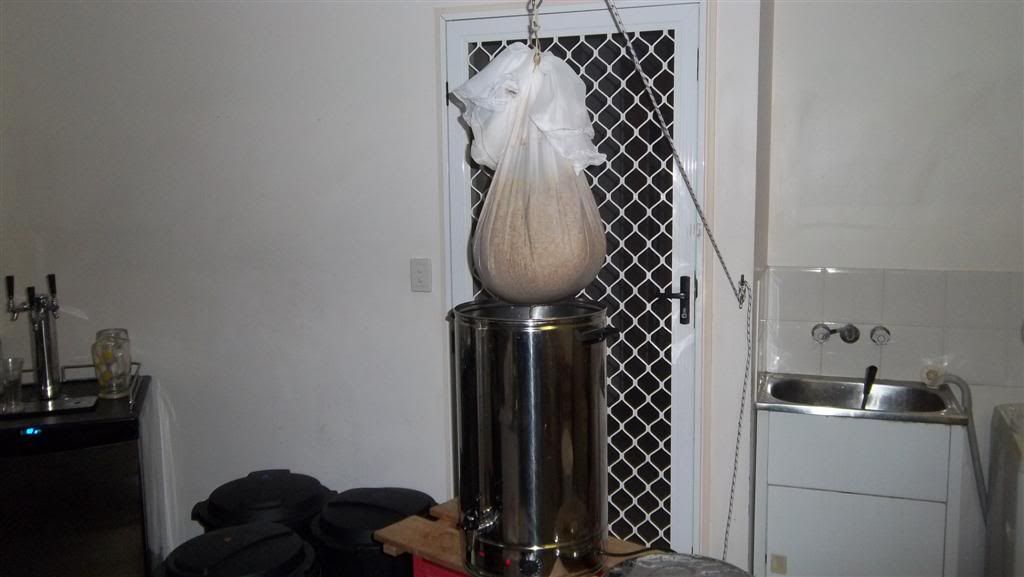
Works really well using a hangman's noose to hang it off the skyhook, and is so easy to clean it's ridiculous - dump grain into compost, flap like a big flag and rinse.
Just a thought for a spare or main bag for just a few dollars cost, around $A 8.50.

Last edited by Beachbum on 30 Nov 2011, 14:08, edited 4 times in total.
Post #18 made 14 years ago
Ok, so two more quick questions and I think I'll have this worked out. At least to the point where I'll be ready to brew. We'll see if I do it different next time.stux wrote:Running some numbers...
Now lets try 1 Kettle for Mash and 1 for sparge, both are limited to 28L for "mash volume"
Impossible without a sparge
So, lets do a 13L sparge. That means we should have 27.8L of Dunk Sparge Volume and 28L of main mash volume
Dough-in 9.67KG of grain in 21.23L of water for 28L of mash. L:G = 2.2L quite thick
First run-off 'should' be 13.42L at 1.109 (wonder if that's reliable). That will leave about 50% of the sugars behind though.
Then dunk the bag into 13L in your other pot. That should dilute the remaining 50% of sugars by 50% and you should end up with 13L of 2nd runnings.
Add as much of your second runnings as you can to your boil pot, my estimate is 10.86L, and then you should have 25L of 1.084
Boil that down adding the remaining sparge as soon as you can, and then an additional 0.5L of topup
That *should* end up with 75% End of Boil Efficiency and 68.7% or so into fermenter efficiency.
1. As you stated above, It's obvious to me that I need to dunk sparge to pull this off the way I want to, but my question is, how much water to use for the mash and how much for the sparge. If I read correctly you are suggesting 21.23L in the mash pot and 13L in the sparge pot. I know the more water to grist the better, but isn't it also true that the larger the sparge volume, the better. Would this mean you would want to split the water 50/50 so you can get the most out of both? I suppose with this particular set up I'm at the limit of my pot in both cases but if I were to consider doing a smaller 4 gallon batch, would you change the ratio?
2. My other question is, if I'm going boil down 2 gallons for carmelization, would it be better to take that from the first runnings which have the highest gravity, or remove it from the pot after the first and second runnings have been combined? I'm thinking first runnings.
Ok, I lied. 3 questions. I think I'm starting to understand the spread sheet. You don't happen to have a copy of it that uses US measurements do you? I thought I read a post somewhere where someone was going to convert it but I didn't see a link to download it.
Last edited by de5m0mike on 30 Nov 2011, 21:36, edited 4 times in total.
Post #19 made 14 years ago
Here's a link to a thread with a copy Here post #4de5m0mike wrote:Ok, I lied. 3 questions. I think I'm starting to understand the spread sheet. You don't happen to have a copy of it that uses US measurements do you? I thought I read a post somewhere where someone was going to convert it but I didn't see a link to download it.
Last edited by Yeasty on 01 Dec 2011, 01:30, edited 4 times in total.
Why is everyone talking about "Cheese"
-
- SVA Brewer With Over 50 Brews From Great Britain
-
Post #20 made 14 years ago
Ok, I give up. what's the trick for switching it to US?
I swear, if I never had to use Excel. I'd be a happier man.
I swear, if I never had to use Excel. I'd be a happier man.
Post #21 made 14 years ago
Oh, I figured it out. I opened the wrong spread sheet after downloading. The US capable one is not actually the same as Stux's. No offense, but Stux's is a bit simpler for a newb like myself to understand. If there is a us version of Stux's calculator out there I'd love to know. In the mean time, I'll give this other one a shot and see if I can't figure it out.
Post #22 made 14 years ago
On the Volumes sheet look at cells 1G and 1H. It will say US Imperial or Metric. I think yours may say metric.
Click on one of the cells then on the little tab that appears. You will then see a drop down allowing you to change measurment units.
Check out this screen dump of what to look for..http://www.biabrewer.info/download/file.php?id=583
Click on one of the cells then on the little tab that appears. You will then see a drop down allowing you to change measurment units.
Check out this screen dump of what to look for..http://www.biabrewer.info/download/file.php?id=583
Last edited by Yeasty on 01 Dec 2011, 02:20, edited 4 times in total.
Why is everyone talking about "Cheese"
-
- SVA Brewer With Over 50 Brews From Great Britain
-
Post #23 made 14 years ago
Quite possibly. You can play a what if game to work this out, so dial your fermenter volume to 4 gals, then play with the sparge number. Ideally you want to find a sparge number that maximizes your expected end of boil efficiencyde5m0mike wrote:Ok, so two more quick questions and I think I'll have this worked out. At least to the point where I'll be ready to brew. We'll see if I do it different next time.stux wrote:Running some numbers...
Now lets try 1 Kettle for Mash and 1 for sparge, both are limited to 28L for "mash volume"
Impossible without a sparge
So, lets do a 13L sparge. That means we should have 27.8L of Dunk Sparge Volume and 28L of main mash volume
Dough-in 9.67KG of grain in 21.23L of water for 28L of mash. L:G = 2.2L quite thick
First run-off 'should' be 13.42L at 1.109 (wonder if that's reliable). That will leave about 50% of the sugars behind though.
Then dunk the bag into 13L in your other pot. That should dilute the remaining 50% of sugars by 50% and you should end up with 13L of 2nd runnings.
Add as much of your second runnings as you can to your boil pot, my estimate is 10.86L, and then you should have 25L of 1.084
Boil that down adding the remaining sparge as soon as you can, and then an additional 0.5L of topup
That *should* end up with 75% End of Boil Efficiency and 68.7% or so into fermenter efficiency.
1. As you stated above, It's obvious to me that I need to dunk sparge to pull this off the way I want to, but my question is, how much water to use for the mash and how much for the sparge. If I read correctly you are suggesting 21.23L in the mash pot and 13L in the sparge pot. I know the more water to grist the better, but isn't it also true that the larger the sparge volume, the better. Would this mean you would want to split the water 50/50 so you can get the most out of both? I suppose with this particular set up I'm at the limit of my pot in both cases but if I were to consider doing a smaller 4 gallon batch, would you change the ratio?
But you're right, the more you sparge the thicker your mash, the thing is the more you sparge the more efficient the whole process, which makes the grain requirement less, which makes the mash thinner!
I think first runnings, and normally I think first runnings is suggested if you want more caramalizibg2. My other question is, if I'm going boil down 2 gallons for carmelization, would it be better to take that from the first runnings which have the highest gravity, or remove it from the pot after the first and second runnings have been combined? I'm thinking first runnings.
Still think you should do a 120 min boil btw
[/quote]Ok, I lied. 3 questions. I think I'm starting to understand the spread sheet. You don't happen to have a copy of it that uses US measurements do you? I thought I read a post somewhere where someone was going to convert it but I didn't see a link to download it.
No US version of *this* spreadsheet *yet*, will get around to it soonish
Last edited by stux on 01 Dec 2011, 05:48, edited 4 times in total.
Fermenting: -
Cubed: -
Stirplate: -
On Tap: NS Summer Ale III (WY1272), Landlord III (WY1469), Fighter's 70/- II (WY1272), Roast Porter (WY1028), Cider, Soda
Next: Munich Helles III
5/7/12
Cubed: -
Stirplate: -
On Tap: NS Summer Ale III (WY1272), Landlord III (WY1469), Fighter's 70/- II (WY1272), Roast Porter (WY1028), Cider, Soda
Next: Munich Helles III
5/7/12
Post #24 made 14 years ago
That's good news my new ce calc is easier to understand than the original BIAB Calculatorde5m0mike wrote:Oh, I figured it out. I opened the wrong spread sheet after downloading. The US capable one is not actually the same as Stux's. No offense, but Stux's is a bit simpler for a newb like myself to understand. If there is a us version of Stux's calculator out there I'd love to know. In the mean time, I'll give this other one a shot and see if I can't figure it out.
The important thing is that only the ce calc is currently capable of actually working this stuff out
Last edited by stux on 01 Dec 2011, 05:51, edited 4 times in total.
Fermenting: -
Cubed: -
Stirplate: -
On Tap: NS Summer Ale III (WY1272), Landlord III (WY1469), Fighter's 70/- II (WY1272), Roast Porter (WY1028), Cider, Soda
Next: Munich Helles III
5/7/12
Cubed: -
Stirplate: -
On Tap: NS Summer Ale III (WY1272), Landlord III (WY1469), Fighter's 70/- II (WY1272), Roast Porter (WY1028), Cider, Soda
Next: Munich Helles III
5/7/12
Post #25 made 14 years ago
I was planning on a 90 min. but hadn't considered 120. That actually just made me realize that your spread sheet doesn't ask for boil time. I suppose it doesn't need to if you figure out and enter the correct Total Evaporation on line 13. I on the other hand, had left this at the default 3.8L without thinking. This is just a thought, but maybe you should have that be one of the "red" figures so it isn't accidentally overlooked. Especially since it could change from batch to batch. Actually, if it were up to me I think it would make more sense to have an "evaporation rate" in liters per hour be a bold value that you can tweek over time and then add a new "red" boil time field.stux wrote: Still think you should do a 120 min boil btw
And if I'm going to make suggestions, I might also say that I think it would be nice to have the "Brew Day Result" section on it's own page. Two reasons for this. When I first saw the "Extract & Losses" chart at the bottom, I thought this was suppose to be changing with the numbers I was putting it. It took me a while to figure out it was for after the fact, based on actual brew day results. Keeping this separate might make it less confusing. My other reason, and this is pretty minor, is that it would be nice to have it fit a little better on a sheet of paper when I print it. Right now everything has to get pretty small to fit on a page. I'd rather be able to print them separately for my records. You know, one page for my target, and one for actual results. Anyway, just something to think about. Of course, I'd rather see US measurements before any of that anyway.
Either way, Keep up the good work.

Last edited by de5m0mike on 01 Dec 2011, 22:13, edited 4 times in total.
